Heat Armor

The technology behind Heat Armor

Built to Cool. Built to Protect.

Protection starts where sunlight meets your walls.

Heat Armor is a ceramic- and mineral-based acrylic coating engineered to help keep exterior walls cooler while providing a durable, protective finish.

One coating. Three complementary jobs.

Reflect sunlight. Release heat. Protect your walls.

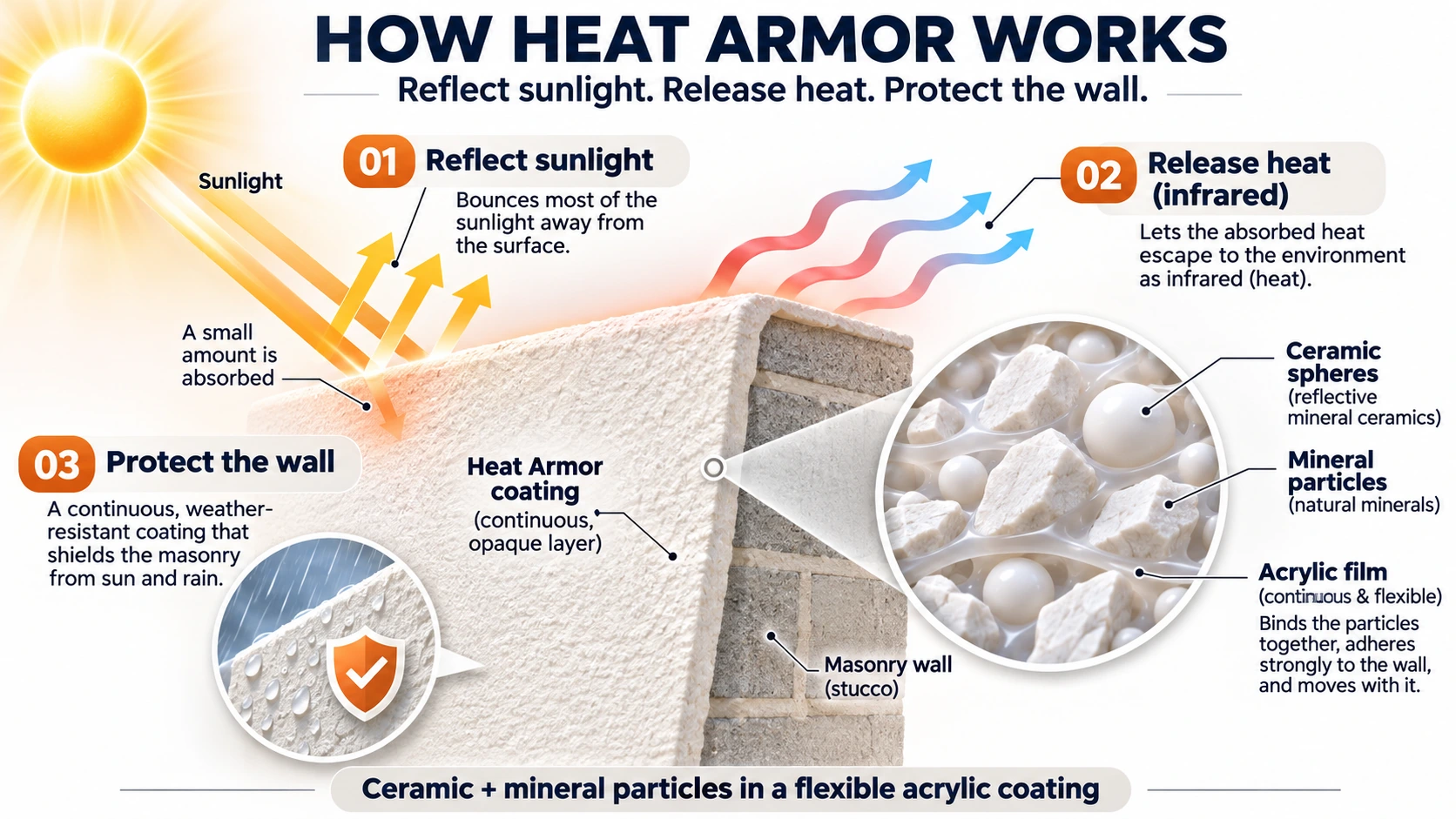
Follow the numbered diagram to see how the coating manages solar heat at the surface and forms a protective exterior finish.

Conceptual Heat Armor diagram showing sunlight reflected at the wall, absorbed heat released as infrared energy, and ceramic and mineral particles bound within a flexible acrylic coating.
Tap the diagram to open a larger, readable view.Conceptual illustration of the coating system and heat pathways. The arrows and material callouts explain design intent, not measured performance.

Inside the coating system

Materials with a purpose.

Reflective pigments, ceramic particles, and functional minerals work together within an acrylic binder to manage solar heat and support a strong, flexible coating.

01

Solar reflectance

Reflect sunlight. Reduce heat absorption.

Heat Armor helps reflect incoming sunlight so less solar energy is absorbed by the surface. This helps keep sun-exposed walls cooler and can reduce heat moving through the wall—all without electricity.

02

Thermal emission

Release heat through thermal emission.

Heat Armor also releases absorbed heat as invisible infrared energy—a natural process called thermal emission. Together, solar reflectance and thermal emission support passive cooling at the wall’s surface.

03

Durable protection

Create a durable, flexible finish.

The acrylic binder anchors the coating to properly prepared surfaces and holds its ceramic and mineral components together. The formulation is designed to balance adhesion, flexibility, and reinforcement, helping the finish withstand outdoor exposure and accommodate normal surface movement.

Building-specific performance

Performance depends on color, surface preparation, application thickness, building conditions, and weather.

Heat Armor is not a structural repair, waterproofing membrane, or insulation replacement. Final-formulation properties and individual building results require appropriate evidence.

FAQs

Questions about the science.

Short explanations of the two heat processes, the preparation the coating depends on, and the variables that change results.

Solar reflectance is the share of incoming sunlight a finished surface sends back out instead of absorbing. It covers visible light and near-infrared energy, the parts of sunlight that deliver most of the heat you feel on a wall. A more reflective surface absorbs less energy, so it heats up more slowly in the sun. Reflectance is a property of the finished surface — color, pigments, and surface texture all influence it — which is why a reflective white finish is the starting point for Heat Armor.

See how this applies to your building.

Request a quote for an assessment, or review the technical documents behind the coating system.